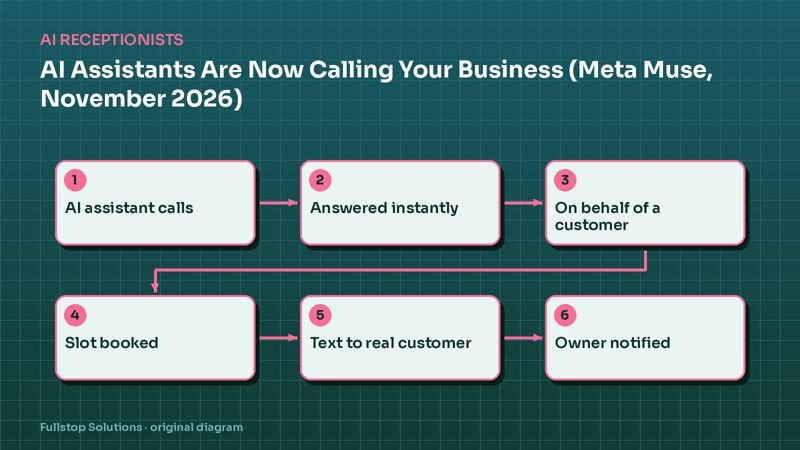
Short answer: on November 12, 2026, Meta made phone calling available in its Muse AI agent for paid subscribers in the U.S. Muse can now call businesses to book appointments, make reservations and wait on hold on behalf of its user, and similar calling options already exist from Instinct and Google's Gemini. If you run a dental office, pest control company or home-service business, some of your callers will soon be AI assistants acting for real customers. Don't hang up on them. Answer every call, verify the person behind the request, confirm directly with that person by text, and never share sensitive information with a caller you have not verified.
This article summarizes reporting from TechCrunch, Engadget and Business Operations Pro. Features and availability may change. We are not affiliated with Meta.
Published November 13, 2026.
What changed
According to TechCrunch, Meta tested outbound calling with a small group of Muse users starting in September, and on November 12 opened it to anyone with a paid Muse subscription in the U.S. Plans start at $20 per month. Meta says Muse has more than 10 million users. Meta's chief AI officer, Alexandr Wang, pitched it for "calls you don't want to make": insurance, cable, the DMV, or a restaurant that does not take online reservations. Engadget adds scheduling appointments and waiting on hold to the list.
Muse is not alone. TechCrunch notes that the startup Instinct and Google's Gemini offer similar calling, and Engadget mentions Google's "Call For Me" feature on Pixel phones and Instinct's "Concierge" feature.
| What the AI caller does | What it means for your front desk |
|---|---|
| Calls to book, reschedule or ask for the next available appointment | A real customer wants a slot. This is a booking request. |
| Works through phone menus and waits on hold | A long menu or hold queue no longer filters these callers out. They wait. |
| Says it is calling on someone's behalf | Ask for the customer's name and callback number, then confirm with that person. |
| May not clearly say it is an AI | Train staff to recognize the pattern rather than relying on a disclosure. |
What early data shows
Voice security company Pindrop has measured Muse calls to its customers. As reported by Business Operations Pro, for calls between September 9 and October 6, 2026:
- 64% of Muse calls reached a human agent, and 47% pressed keypad digits to get through the phone menu.
- A typical call that reached a person spent about 2 minutes 1 second in the phone menu, then 2 minutes 18 seconds with the agent.
- Healthcare was the second most-called sector after financial institutions, followed by retail.
- By the fourth week, weekly Muse call volume was eight times the first week's level.
These numbers come from Pindrop's customers' contact centers, such as banks, healthcare providers and retailers, so a small dental office or pest control company should not expect the same volume. The direction is still clear: these agents push through phone trees, wait on hold, and then want to talk to someone who can help.
Why hanging up is the wrong default
TechCrunch reports that many businesses and receptionists hang up as soon as they realize the caller is not a human. That is an understandable reflex, but the agent is usually calling because a real person asked it to. A homeowner who tells their assistant "find a pest control company that can come Thursday" will book with whichever business answers and can give a time. Hang up, or let it ring to voicemail, and that customer is booked with someone else. We have written about what missed calls cost; an AI caller you turn away is the same lost job.
It is also getting harder to tell the difference. TechCrunch notes that AI voices now mimic people well. In a call Engadget described, between Muse and a Volvo dealership, Muse did not explicitly say it was an AI, but it did say it was calling on its user's behalf and that it was transcribing the call.
As NiCE's Neeraj Verma put it in comments cited by Business Operations Pro, "neither blocking nor welcoming is a strategy on its own." What works is a simple policy: identify who or what is calling, verify the customer behind it, and limit what the agent can do.
A front-desk playbook for AI callers
Use this with your staff or build it into your AI receptionist script:
- Treat it as a customer request. Be polite and efficient. The goal is the same as with any caller: understand what the customer needs and book it.
- Ask who it is for. "Are you calling on behalf of someone? What is their full name and the best callback number?" Write both down.
- Offer real times. Give two or three available slots, or the earliest one, just as you would to a person.
- Confirm with the real customer by text. Send a confirmation to the customer's own number, for example: "Hi Maria, your cleaning at Smile Dental is booked for Thu 10:30 AM. Reply YES to confirm or call us to change." Include a clear opt-out line (see our TCPA opt-out rules guide).
- Never share sensitive information with an unverified caller. No protected health information, account details or card numbers. For dental and medical offices, that means not reading back treatment details, balances or insurance information to an agent. Verify the patient directly first, using the contact details you already have on file. Our guide to HIPAA-aware automation for healthcare practices covers the basics.
- Take payments and sensitive changes directly with the customer. Send a secure link or call the customer back instead of taking a card number from the agent.
- Log the call. Note that it came from an AI assistant so you can spot patterns and adjust your script.
Make your business easy to book, for people and their assistants
- Online booking link on your website and Google profile, so an assistant can book without calling at all.
- Clear hours, service area and starting prices on your website. Vague pages lead to longer calls and wrong answers. The same applies to AI search: see our guide to claiming your business in ChatGPT.
- A short phone menu. One or two options, with a fast path to booking.
- Answer every call, including after hours. An AI assistant can call at 9 PM as easily as at 9 AM. See after-hours calls for dental practices and missed-call text back for HVAC.
Where an AI receptionist fits
An AI voice receptionist answers instantly, 24/7, and follows the same steps for every caller, human or AI: it asks who the call is for, collects the details, books into your calendar, texts a confirmation to the real customer and notifies your team. Requests that involve payment, protected health information or anything unusual get handed to a person, as described in our guardrails and human handoff guide. Pair it with missed-call text back and lead follow-up so any call that does slip through gets a reply within a minute.
It will not turn every call into a booking, and you should still review transcripts in the first few weeks. But it means no caller, and no assistant calling for a customer, reaches voicemail.
How we help
We are an AI automation agency, not Meta. We set up AI receptionists, missed-call text back and booking flows for dental practices, pest control companies and home-service businesses such as HVAC and plumbing companies, including scripts and verification rules for calls from AI assistants. If you already have a receptionist or answering service, we can review your call flow against the playbook above.
Related guides
- AI receptionist guide for small businesses
- AI receptionist vs answering service
- AI agents for small business
- How to claim your business in ChatGPT
Want to know what happens when an AI assistant calls your business tonight? Book a free automation audit or contact us.