Short answer: a live answering service gives callers a human who can show empathy and handle the unexpected, but usually takes messages rather than booking into your systems. An AI receptionist picks up instantly, gives consistent answers, books directly into your calendar and costs less as volume grows, but it needs clear rules and a fast human fallback. For many small businesses the best answer is a hybrid: AI for routine calls and after-hours triage, people for sensitive conversations.
What each option really is
Live answering service: a team of remote receptionists answers your calls using a script you provide. They typically take messages, sometimes book appointments in shared calendars, and page on-call staff for emergencies. Quality depends on the service, the script and the specific person who answers.
AI receptionist: software that answers with a synthetic voice, understands requests, answers from your approved knowledge base, takes actions in connected systems (booking, texting links, creating leads) and transfers or takes messages when rules require. Quality depends on the setup: the knowledge it can use, the integrations and the hand-off rules.
Side-by-side comparison
| Factor | Live answering service | AI receptionist |
|---|---|---|
| Pickup | Usually fast; may queue at peaks | Instant; handles simultaneous calls |
| Empathy with upset callers | Strong, varies by agent | Limited; should hand off quickly |
| Unusual requests | Handles with judgment | Needs a fallback rule |
| Consistency of answers | Varies by agent and script | Same answer every time |
| Booking into your systems | Often messages only; depends on the service | Direct booking where APIs exist |
| Data in your CRM | Usually a message summary | Structured fields and full transcript |
| After-hours cost | Often same rate or higher | Same as daytime |
| Cost structure | Per minute or per call, often with minimums | Platform fee plus usage |
| Quality control | Spot checks; agent turnover | Full transcripts; rule changes apply instantly |
| Language coverage | Depends on the service | Many systems support multiple languages |
Where a live service wins
- Sensitive first contacts. A grieving family calling a funeral home, a frightened person calling a defense attorney, a distressed pet owner: these calls deserve a human.
- Low volume, high complexity. If you get a few long, complex calls a day, a human's judgment is worth the per-minute cost.
- Callers who strongly prefer people. Some customer bases are less comfortable with automated systems. You know your callers.
Where an AI receptionist wins
- High volume of routine calls. Hours, directions, "is my car ready", appointment changes.
- Booking-heavy businesses. Dental, salons, auto repair, home services: direct booking into real availability saves a callback loop.
- Peaks. When ten people call at once after a storm or on a Monday morning, AI does not queue.
- Data quality. Every call becomes a structured record with a transcript, which helps you see why people call.
The hybrid most businesses end up with
- AI answers first after hours and on overflow.
- Routine requests (booking, FAQs, status) are completed by the AI.
- Hand-off triggers (emergency, distress, specific topics, "I want a person") transfer to staff during hours, or to a live answering service or on-call staff after hours.
- Everything is logged in the CRM with a summary and transcript.
This keeps the human touch where it matters and removes the routine load from everyone.
Running the comparison with your numbers
Ask both kinds of vendors for pricing based on the same inputs:
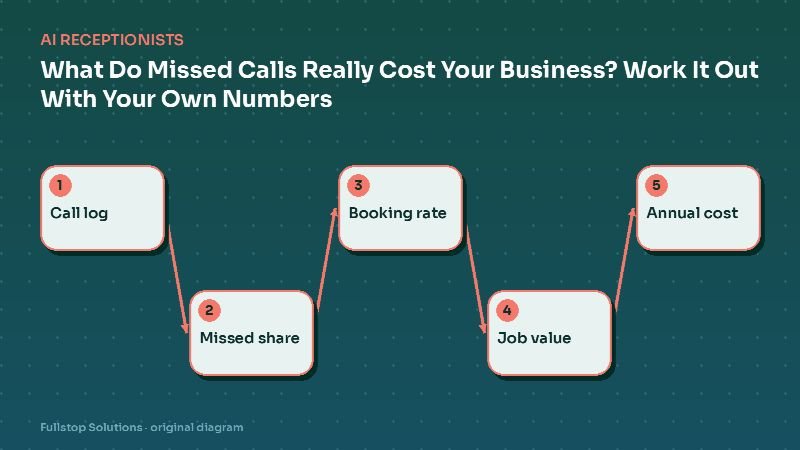
- Monthly calls: from your phone system's call log.
- Average call length: also from the log.
- After-hours share: what share of calls arrive outside business hours.
- Booking share: what share of calls should end in an appointment.
Then compare total monthly cost, and separately compare what happens to the booking calls: does the option book directly, or create a message that someone has to call back? A callback loop costs staff time and loses some callers, which a per-minute price does not show.
Quality questions to ask any vendor
- Can I hear recordings or read transcripts of every call?
- How do I change the script or knowledge, and how fast does it take effect?
- What happens when the caller asks for a person?
- How are emergencies escalated, and what if nobody acknowledges?
- Where is call data stored, who can access it, and will you sign the agreements my industry requires?
- How do callers in different states get the right recording disclosure?
A note on outbound calls
Everything above concerns inbound calls, where people call you. If you are considering AI voice for outbound calls, the FCC states that AI-generated voice calls are illegal unless the consumer has agreed to receive them or the caller is exempt. That is a separate decision with separate consent requirements.
Industry quick takes
- Home services: AI-first with emergency paging works well; see our home services page.
- Dental: AI for scheduling and after-hours, humans for clinical concerns; see after-hours calls for dental practices.
- Law firms: many prefer humans for first contact and AI for scheduling and overflow; see law firm automation.
- Auto repair: AI handles status calls and booking well; see AI phone answering for auto repair.
Running a fair side-by-side trial
If you are unsure which option suits you, run both for a few weeks on part of your calls. For example, send after-hours calls to the AI receptionist and lunchtime overflow to the answering service, then swap. Before you start, agree what you will measure:
- share of calls answered,
- bookings made without staff involvement,
- messages that needed a callback to clarify details,
- urgent calls routed correctly,
- caller complaints,
- total cost for the period, including per-minute or per-call charges.
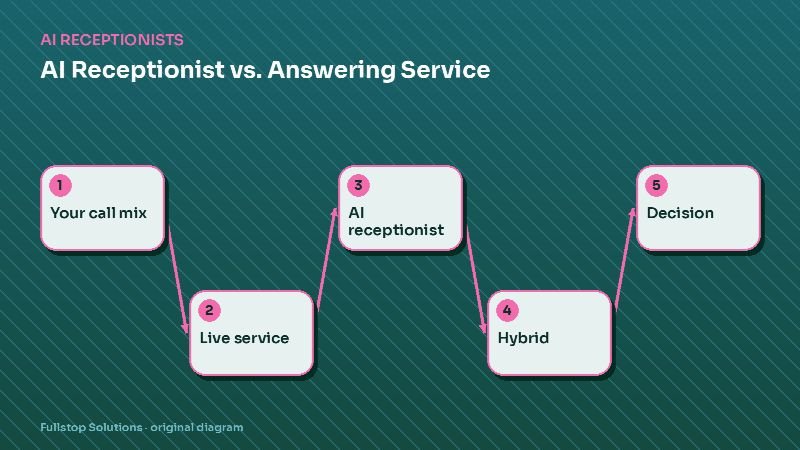
Listen to a set of recordings from each, and read the summaries both produce. The decision often comes down to call mix: mostly routine booking and questions favor the AI receptionist, while calls needing empathy and judgment favor people.
Bottom line
Do not decide on the voice demo. Decide on your call mix: how many calls are routine, how many need judgment, and how many should become appointments. Then choose the option, or the hybrid, that handles each kind best. The AI receptionist pillar guide covers rollout, and our AI voice receptionist service explains how we set up hybrids with your existing answering service.