Short answer: the FCC's updated TCPA consent-revocation rules take effect November 25, 2026. If your business uses missed-call text back, automated SMS follow-up or an AI phone agent, check five things before then: an opt-out line in every text, recognition of all seven standardized opt-out words, opt-outs that sync to every tool that can text or call, a clean split between informational and marketing messages, and recorded consent before any outbound AI voice call.
This article summarizes the Federal Register notice published October 26, 2026, an FCC ruling and a law-firm summary. It is not legal advice. State laws can add requirements; check your setup with your own counsel.
Published November 1, 2026.
What changed, in plain English
The FCC's order (FCC 26-67, CG Docket No. 02-278) amends 47 CFR 64.1200. The parts that matter most for small-business automation:
| Change | What it means for your texts and calls |
|---|---|
| Exclusive opt-out method | You may designate one of three methods as the only way to revoke consent: (1) an automated voice or key-press opt-out during a call, (2) a reply text using standardized words, or (3) a website or phone number you designate. It must be clearly and conspicuously disclosed on the call or in the text. |
| Standardized words | The words are stop, quit, end, revoke, opt out, cancel and unsubscribe. If reply text is your exclusive method, each text must include at least one of them (for example "Reply STOP to opt out"), and you must honor all seven. |
| No exclusive method designated | You must keep honoring opt-outs made in any reasonable manner, such as "please stop texting me". |
| Informational vs marketing | An opt-out sent in reply to an informational message (no advertising or telemarketing) may be treated as covering only that category of informational messages. An opt-out sent in reply to a marketing or telemarketing message revokes consent for all future marketing calls and texts from you. |
| Timing and confirmation | Opt-outs must be honored within a reasonable time, not more than ten business days. One confirmation text is allowed if it only confirms the opt-out and has no marketing; sent within five minutes, it is presumed to fall within the consumer's prior consent. |
| One-way texting | If you use a texting protocol that cannot receive replies, each text must say two-way texting is not available and give reasonable alternative ways to opt out. |
Two things did not change. Artificial or prerecorded telemarketing calls still need the in-call automated voice or key-press opt-out under 47 CFR 64.1200(b)(3), as the CommLaw Group summary notes. And the consent requirements themselves still apply: the new rules are about how people withdraw consent.
The FCC also opened a companion notice asking, among other questions, whether to eliminate one-way texting protocols that do not accept reply-text opt-outs. Comments on it are also due November 25, so expect more changes.
The compliant missed-call text back flow
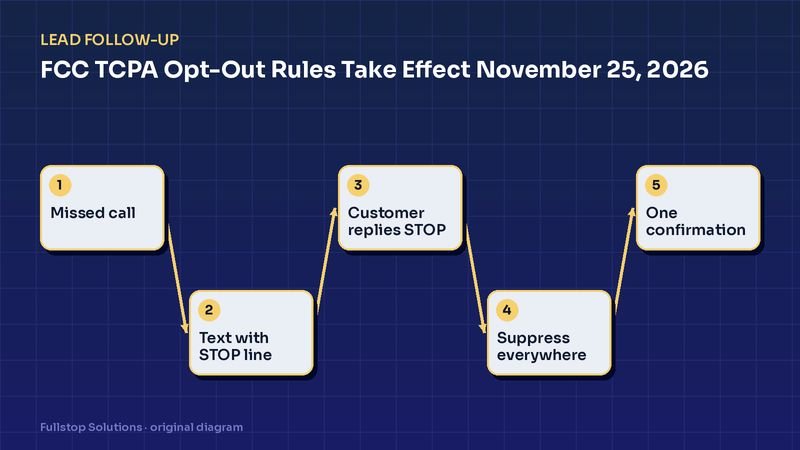
Here is the flow we recommend reviewing for a missed-call text back or SMS follow-up setup:
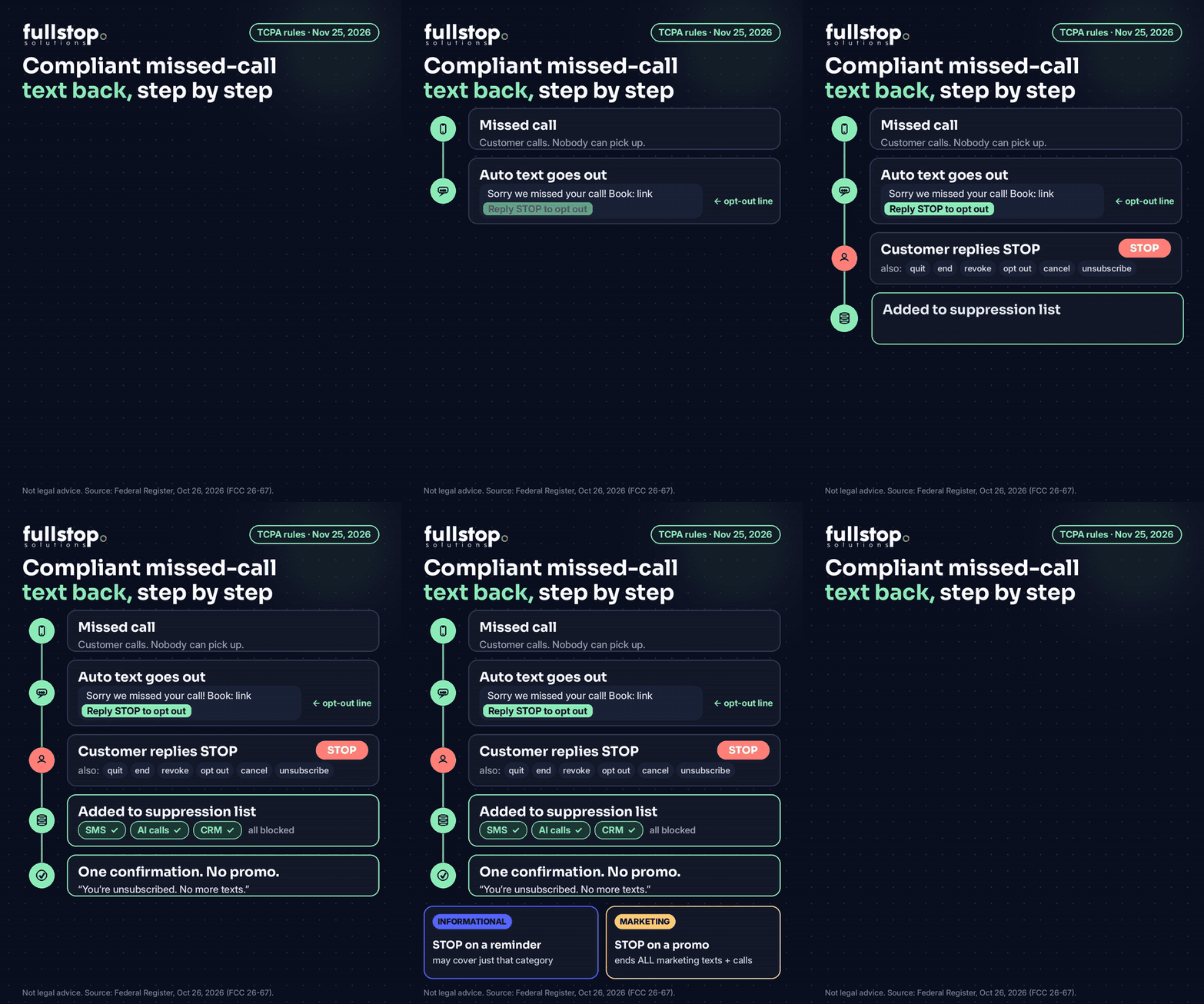
- A call is missed. The trigger is a call the person placed to your number.
- The auto-text names your business, refers to the missed call and includes an opt-out line, for example: "Hi, this is Lakeside Dental. Sorry we missed your call. Reply here or book at [link]. Reply STOP to opt out."
- The customer replies STOP (or quit, end, revoke, opt out, cancel, unsubscribe).
- The number goes on a suppression list that every tool reads before sending: your SMS platform, your CRM sequences and any AI voice agent that places outbound calls.
- One confirmation text goes out ("You're unsubscribed and won't get more texts from Lakeside Dental"), with no offer attached. Then nothing else.
For a deeper setup guide, see TCPA text consent, A2P 10DLC and missed-call text back compliance and our lead intake and follow-up automation service.
Informational vs marketing: design two lanes
The category rule rewards businesses that already keep message types apart. If an appointment reminder also carries a coupon, it is harder to argue it was purely informational.
- Informational lane: missed-call replies, appointment reminders, job status, "your technician is 20 minutes out", payment receipts. A STOP here may be scoped to that category of informational messages under the new rule.
- Marketing lane: promotions, seasonal offers, reactivation campaigns, review-plus-discount messages. A STOP here ends all future marketing calls and texts from you, and marketing still needs prior express written consent.
Practical tips:
- Tag every template in your SMS tool as informational or marketing, and store that tag with each sent message.
- Keep offers out of reminder and missed-call threads unless you hold written marketing consent for that person.
- If tracking categories feels risky for your team, suppress broadly on any STOP. It is simpler, and you can still offer a way to opt back in.
What this means for AI phone agents
In its February 2024 declaratory ruling (FCC 24-17), the FCC concluded that AI-generated human voices count as an "artificial or prerecorded voice" under the TCPA. So:
- Outbound AI voice calls (reminders, follow-ups, reactivation) need prior express consent, and prior express written consent if they are telemarketing.
- If your AI agent places artificial-voice telemarketing calls, it still needs the in-call automated opt-out (voice or key-press).
- An opt-out captured by text should stop the AI agent from calling that number too, if the opt-out covers those calls. That means the AI agent has to read the same suppression list as your SMS tool.
- An AI receptionist answering calls that people place to you is a different case from outbound AI calls, but any texts it sends afterward still follow the texting rules above.
By industry
- Dental practices: keep recall and appointment reminders (informational) separate from whitening or implant promotions (marketing). A STOP on a promo should not quietly leave the patient in a reactivation campaign. See dental practice automation and after-hours calls for dental practices.
- Pest control: service-window texts and renewal reminders are a different lane from "add mosquito treatment this season" offers. See pest control automation and recurring service automation.
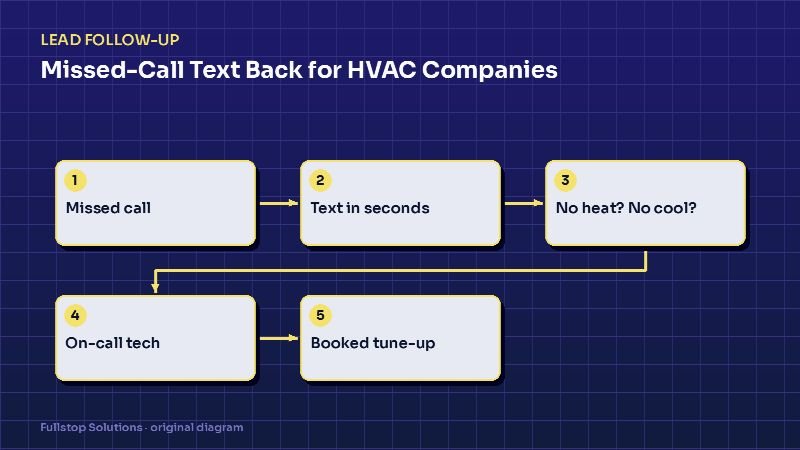
- Home services: emergency dispatch updates and missed-call replies are informational; maintenance-plan upsells are marketing. See missed-call text back for HVAC.
Checklist before November 25, 2026
- Every automated text includes an opt-out line with at least one standardized word ("Reply STOP to opt out").
- Your system recognizes all seven words: stop, quit, end, revoke, opt out, cancel, unsubscribe, in any capitalization.
- Decide whether you designate an exclusive opt-out method. If not, your team still honors plain-language requests like "don't text me".
- Opt-outs sync to one suppression list read by every SMS tool, CRM sequence and AI voice agent, ideally within minutes, never beyond ten business days.
- The confirmation text is single, prompt and free of marketing.
- Each template is tagged informational or marketing; promos never ride on reminder or missed-call threads.
- Written consent is recorded (wording, time, source, phone number) before marketing texts or outbound AI voice calls.
- Artificial-voice telemarketing calls include an in-call voice or key-press opt-out.
- Any one-way texting number either gets replaced or carries the required disclosure and an alternative opt-out.
- Counsel has reviewed the setup for the states you operate in.
How we help
When we build missed-call text back, SMS follow-up or AI receptionist automations, we set up the opt-out keyword handling, the shared suppression list, template tagging and consent records as part of the build. If you already run these tools, we can review your current flows against this checklist and show you what to fix. We are an automation agency, not a law firm, so we will flag questions for your counsel rather than answer them.
Related guides
- TCPA text consent, A2P 10DLC and missed-call text back compliance
- AI receptionist guide for small businesses
- AI receptionist script checklist
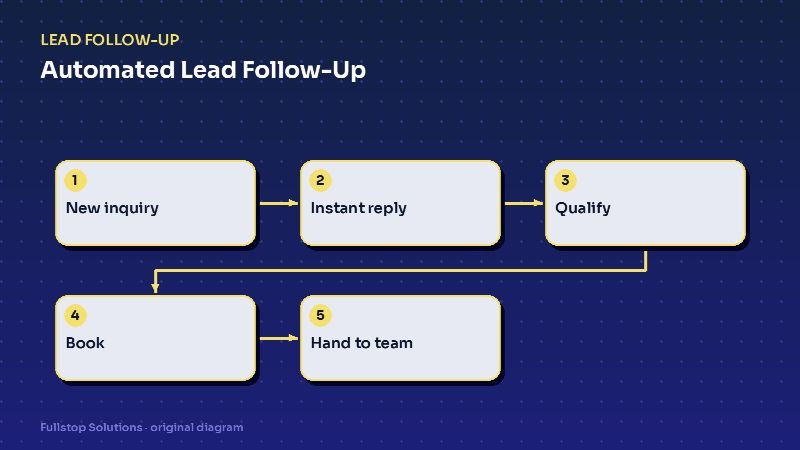
- The complete guide to automated lead follow-up
Want a second pair of eyes on your texting and AI calling flows? Start with a free Missed-Call Audit (includes text-back consent notes), book a consultation, or contact us.