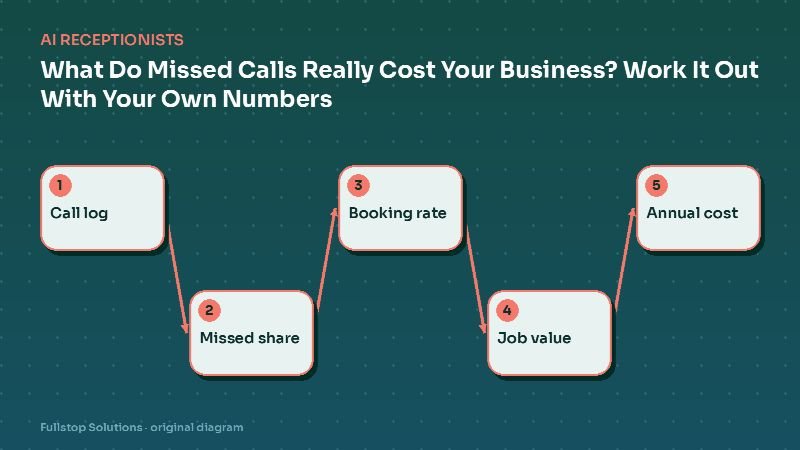
Short answer: the cost of missed calls is roughly missed calls from real prospects × the share who would have booked × the value of a booking, plus the staff time spent on callbacks. You can calculate it in under an hour from your own phone logs. Do not rely on a generic industry statistic: your call mix, close rate and job value are what matter.
Why use your own numbers
You have probably seen confident claims about how many calls small businesses miss and what it costs. Those figures, even when they come from real surveys, describe someone else's business. Yours might be better or worse. The good news is that you already have the data to work it out.
Step 1: Export your call log
Log into your phone system (VoIP provider, carrier business portal, or call-tracking tool) and export at least one month of inbound calls. Three months is better. You want, for each call: date and time, caller number, duration, and outcome (answered, missed, voicemail).
Step 2: Clean the list
Remove what does not represent a potential new booking:
- Spam and robocalls. Very short calls from unknown numbers, repeated patterns.
- Existing customers calling about current jobs (match against your customer list if you can).
- Vendors and personal calls.
- Repeat calls from the same number within a short window; count them once.
- Missed calls that were returned and reached within, say, 15 minutes (if your log or CRM shows callbacks).
What remains is your count of missed prospect calls. Call it M per month.
Step 3: Find your booking rate
Look at answered calls from new prospects over the same period and count how many became a booked appointment or job. Divide booked by answered. That is your booking rate, B.
If you do not track this, pull 30 answered prospect calls and check the outcomes manually. A rough number is far better than none.
Step 4: Find your average booking value
Use your average first-job ticket or first-visit value, V. For businesses with recurring services, we will add lifetime value in a moment.
Step 5: Do the math
Monthly revenue at stake ≈ M × B × V
Example with made-up inputs, just to show the arithmetic: if M = 40 missed prospect calls a month, B = 35%, and V = $300, then 40 × 0.35 × $300 = $4,200 a month, or about $50,400 a year.
Now try it with yours:
This is an upper bound. It assumes the missed callers would have booked at the same rate as the ones you answered. Some would not have; some will call back on their own. That is why Step 8 matters.
Finding your missed calls
Most business phone systems report missed and abandoned calls. Pull a month and split them by hour and weekday; the pattern shows whether the gap is lunch, after hours or peak bursts. Remove known spam numbers and repeat callers who later got through. What remains is your real missed-call count to plug into the formula above.
Step 6: Add the hidden costs
The simple formula leaves out three things:
Callback labor. Every missed call that someone returns costs staff time, and returned calls often reach voicemail again. Estimate: callbacks per month × minutes per callback attempt × loaded hourly cost.
Lifetime value. If a new customer typically returns (dental recalls, HVAC maintenance, lawn care, salon visits), the first booking is only a fraction of their value. Replace V with an estimate of first-year value, or multiply by the number of times a typical customer returns.
Reputation. Unanswered calls show up in reviews ("couldn't get anyone on the phone"). This is hard to price, but real.
Step 7: Look at when calls are missed
Group your missed prospect calls by hour and day. The pattern tells you which fix fits:
- Lunch hour and early morning: overflow coverage or call routing.
- Evenings and weekends: after-hours coverage, such as an AI receptionist or missed-call text back.
- Peaks on specific days (Mondays, first hot day of summer): surge coverage.
- All day, evenly: a staffing or process issue, not just a technology one.
Step 8: Test against reality
Pick the cheapest fix that matches your pattern, for example missed-call text back (see our HVAC missed-call guide), and run it for four weeks. Then compare with the four weeks before:
- missed prospect calls with no contact within 15 minutes,
- bookings from new callers,
- callback hours spent by staff.
The difference is your real, measured cost of missed calls, or at least the part you recovered. It is far more trustworthy than any formula, including ours.
Common mistakes in this calculation
Counting spam. Unfiltered logs can include a lot of junk calls. Clean first.
Using total revenue per customer as V for one-off jobs. Be honest about what a first booking is worth.
Ignoring capacity. If your schedule is full for three weeks, more booked calls may simply mean a longer wait. The value of answering is then partly about choosing better jobs, not just more of them.
Assuming 100% recovery. No fix captures every missed caller. Measure what you actually recover.
What to do with the result
If the monthly number is small relative to the cost of a fix, put your energy elsewhere. If it is large, the fix is usually simple: route overflow, text back missed callers, and cover after hours. The AI receptionist guide explains the options, AI receptionist vs. answering service compares them, and our ROI calculator lets you model the payback with your own costs.
A one-page worksheet
Copy this into a spreadsheet:
| Line | Your number |
|---|---|
| Inbound calls per month (from log) | |
| Missed calls per month | |
| Missed prospect calls after cleaning (M) | |
| Booking rate on answered prospect calls (B) | |
| Average first-booking value (V) | |
| Monthly revenue at stake (M × B × V) | |
| Callback hours per month × hourly cost | |
| Optional: lifetime multiplier | |
| Total monthly cost estimate |
Fill it in once now, and again a month after you fix the leak.