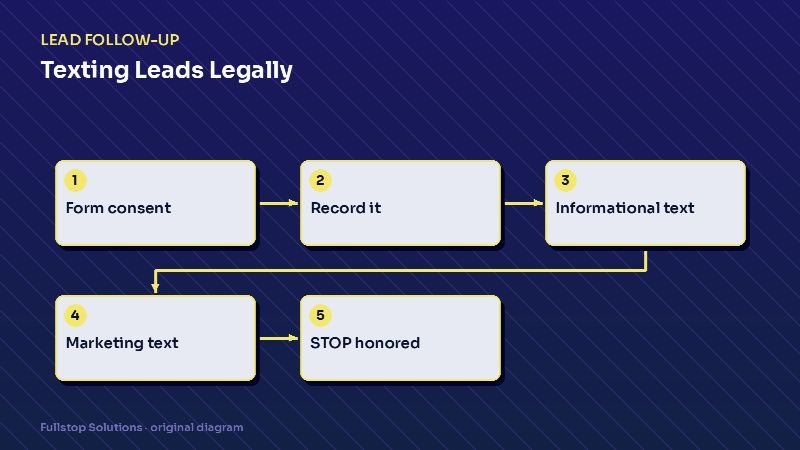
Short answer: before you automate texts to leads or customers, know which kind of message you are sending and what consent you hold for it. The FCC's consumer guidance says autodialed texts to mobile phones require prior consent, commercial (marketing) texts require written consent, informational texts may rely on oral consent, and people can opt out at any time in any reasonable manner. Collect consent clearly, record it, honor opt-outs immediately, and keep marketing separate from service messages.
This article summarizes public guidance from federal agencies. It is not legal advice; state laws can add requirements, and your counsel should review your setup.
Why this matters for automation
Automation makes texting scale. A system that sends one reply per lead is low risk. A system that sends seasonal promotions to thousands of past customers is a marketing program, and the rules that apply to it are stricter. Most problems come from mixing the two: a list built from service conversations gets used for promotions without the consent that marketing requires.
Two kinds of texts
The FCC's consumer page on robocalls and robotexts draws a line that is useful for designing automation:
| Type | Examples | Consent described by the FCC |
|---|---|---|
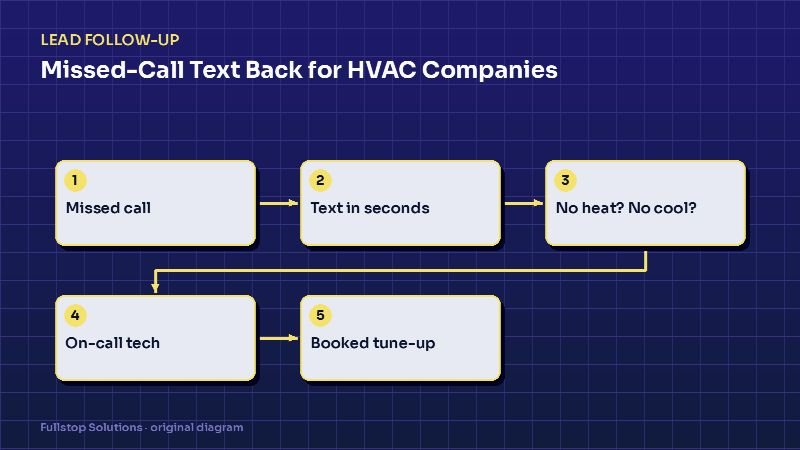
| Informational | Appointment reminders, "we missed your call" replies, job status, payment receipts | Consent may be oral |
| Commercial / marketing | Promotions, discounts, seasonal offers, new-service announcements | Written consent required |
The same page notes that the rules apply even if the recipient's number is not on the National Do Not Call Registry, and that emergency messages are treated differently.
In practice, design your automations so each one is clearly one type or the other. An appointment reminder should not include a coupon. If you want to send coupons, run that from a separate list of people who gave written consent.
What written consent looks like
The FCC notes that written consent can be collected "on paper or through electronic means, including website forms or a telephone keypress" for prerecorded telemarketing calls, and that commercial texts require written consent. For a small business, the common approach is a checkbox on your website or booking form:
"Yes, Comfort Air may send me marketing text messages at the number above. Consent is not a condition of purchase. Message frequency varies. Reply STOP to opt out, HELP for help. Message and data rates may apply."
Good practices around that checkbox:
- Unchecked by default. The person actively opts in.
- Separate from the service request. People can request a quote without opting in to marketing.
- Recorded. Store the exact wording, the time, the form and the phone number. If your consent language changes, version it.
Opt-outs that actually work
The FCC says people "may opt out of any robocall or robotext at any time and in any reasonable manner, even if [they] previously gave consent". For automation, that means:
- Recognize many phrasings. STOP, UNSUBSCRIBE, CANCEL, END, QUIT, and plain-language requests like "stop texting me" or "remove me".
- Act immediately. The opt-out should take effect in your system before the next scheduled message, not at the next weekly sync.
- Apply it everywhere. If you use several tools that can text, an opt-out in one must suppress the number in all of them.
- Confirm once. A single confirmation message ("You're unsubscribed and won't receive more messages") is common; do not send anything else.
Quiet hours
The FCC notes that telemarketing calls to homes are prohibited before 8 a.m. and after 9 p.m. (local time of the person called). Many businesses apply similar quiet hours to all marketing texts as a safe default. Service messages the customer is waiting for, like an emergency dispatch update, are a different situation, but even then, think about whether a 6 a.m. text is necessary.
AI voice and prerecorded calls
If your automation places outbound calls with an AI-generated voice, be careful. The FCC states plainly that "AI-generated voice calls are illegal unless the consumer has agreed to receive them or the caller is exempt", and that prerecorded voice messages must identify the caller's name, number and business at the start. Inbound AI receptionists that answer people who called you are a different case from outbound AI calls to people who did not.
Email is covered too
If your automation also sends email, commercial messages fall under the CAN-SPAM Act. The FTC's compliance guide requires accurate "From" and routing information, a non-deceptive subject line, a clear disclosure that the message is an ad, a valid physical postal address, and a working opt-out honored within 10 business days. The FTC also notes that you cannot contract away responsibility: if a vendor sends email on your behalf, you can both be held responsible.
State rules
Several states have their own telemarketing or texting laws, and some are stricter than federal rules about consent, quiet hours or call frequency. The FCC page notes that many states also keep their own do-not-call lists. If you text customers across state lines, ask your counsel which states' rules apply to you.
A compliance checklist for automated texting
- Every automation is labeled informational or marketing.
- Marketing lists include only people with recorded written consent.
- Consent wording, time and source are stored per contact.
- Opt-out keywords and plain-language requests are recognized.
- Opt-outs sync to every tool that can send messages, immediately.
- Marketing messages respect quiet hours in the recipient's time zone.
- Messages identify your business by name.
- AI or prerecorded outbound calls only go to people who agreed to them.
- Vendors' sending practices are reviewed, because you remain responsible.
- Counsel has reviewed the setup for the states you operate in.
How we handle this in builds
When we build lead intake and follow-up automation, consent capture and opt-out handling are part of the build, not an afterthought: separate consent fields, versioned consent text, global suppression lists, and quiet-hour rules. We also document which flows are informational and which are marketing, so your team knows which list each message can use.