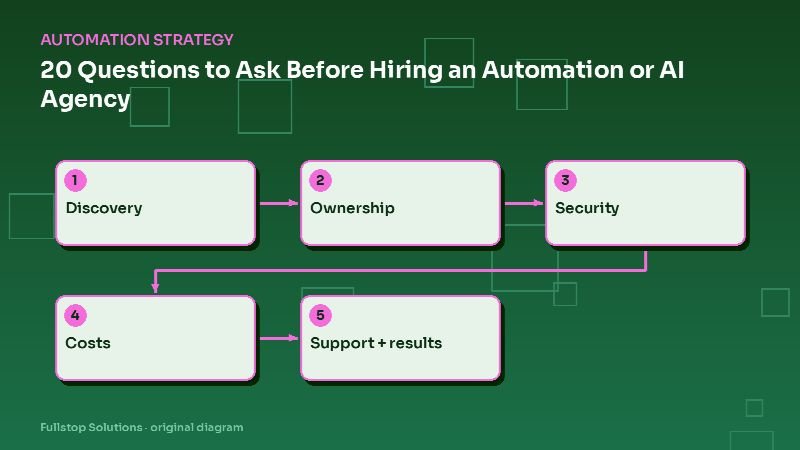
Short answer: before hiring an automation or AI agency, ask how they discover and scope the work, who will own the accounts, code and data, how they handle security and consent, what the full costs are including running costs, who maintains the system after launch, and how results will be measured. Clear, specific answers are a good sign; guarantees and vagueness are not.
Why the questions matter
Automation becomes part of how your business runs. A poor choice of partner can leave you with workflows nobody understands, accounts you cannot access, or costs that grow quietly. A good partner leaves you with documented systems you own and a team that knows how to use them. The difference usually shows up in the answers to a few direct questions.
Discovery and scope
1. How do you decide what to automate? Look for a process that starts with your workflows and numbers, not with a product they want to sell. See the automation audit guide.
2. Who will you talk to in our business? Good discovery includes the people who do the work, not only the owner.
3. What will the written scope include? Expect triggers, steps, tools, exceptions, success measures and what is out of scope.
4. What happens if we discover new requirements mid-project? There should be a clear change process.
Tools and ownership
5. Which tools will you use, and why? They should explain trade-offs, including whether built-in features in your existing software would do. See build vs buy automation.
6. Whose name will the accounts be in? Business-critical accounts should belong to your business.
7. Do we own the code, workflows and data? For custom work, the contract should say so.
8. What documentation will we receive? Each workflow should be documented: trigger, steps, owner, failure alerts.
Security and compliance
9. How will credentials be stored and shared? Look for password managers and least-privilege access, not passwords in emails.
10. How do you handle consent for texts and calls? They should know federal consent rules and build opt-outs in. See SMS follow-up compliance.
11. How do you handle regulated data? For health, legal or financial data, they should discuss vendor agreements and safeguards. See HIPAA and automation.
12. How do AI features avoid making things up? Expect answers about approved knowledge, guardrails and human handoff. See AI guardrails.
Costs
13. What is the full cost for the first year? Build fee plus subscriptions, usage costs and maintenance.
14. How do running costs change as we grow? Per-task, per-message and per-minute pricing can grow with volume.
15. What is included in support, and what is extra?
Launch, support and results
16. How will you test before launch? Look for test cases, a pilot period and a rollback plan.
17. How will our team be trained?
18. Who do we call when something breaks, and how fast do you respond?
19. How will we measure results? They should propose a baseline and specific measures, using your numbers.
20. Can you show us work you have done? Ask for demonstrations of comparable systems. Be wary of claims you cannot verify. The FTC has warned businesses to keep AI claims in check; the same skepticism helps buyers.
Red flags
- guaranteed revenue or lead numbers before seeing your data,
- reluctance to explain how the system works,
- accounts held by the agency with no transfer plan,
- no mention of consent, security or documentation,
- pricing that only covers setup, with running costs left vague.
Good signs
- they ask about your numbers and workflows before proposing tools,
- they suggest starting small,
- they recommend built-in features when those are enough,
- they put ownership and documentation in writing.
Questions to ask yourself
What problem are you solving, and how will you know it is solved? Who in your business will own the systems? What budget range covers both build and running costs? Being clear on these makes every agency conversation more productive.
Scoring the answers you get
After each agency conversation, score their answers from 1 to 3 on five areas: discovery (did they ask about your workflows and numbers?), ownership (will you own the accounts, code and data?), security and compliance (did they raise consent, credentials and regulated data?), costs (did they give a full first-year cost?), and support (is there a named contact and a response time?). A total of 12 or more suggests a thoughtful partner; anything with a 1 in ownership or security deserves a hard second look.
What a good proposal contains
A proposal worth signing usually includes:
- a short description of the problem in your words, showing they listened,
- the workflows in scope and those explicitly out of scope,
- the tools to be used and who will hold each account,
- a timeline with a pilot or test phase,
- the build fee, the expected monthly running costs at your volume, and what changes would cost,
- the documentation and training you will receive,
- how success will be measured, with a baseline,
- what happens at the end of the contract, including a handover.
If a proposal is mostly about features and price, ask for the missing pieces in writing before you compare it with others.
A quick reference check
Ask whether you can speak with a current client, and when you do, ask what happened when something broke. How a partner handles problems tells you more than any demo.
Where to start
Bring this list to every agency conversation, including ours. Our AI automation services explain how we work, the AI readiness assessment helps you prepare, and you can book a consultation to ask these questions directly. Fullstop Solutions is based in Marana, Arizona and works with businesses across the US remotely.