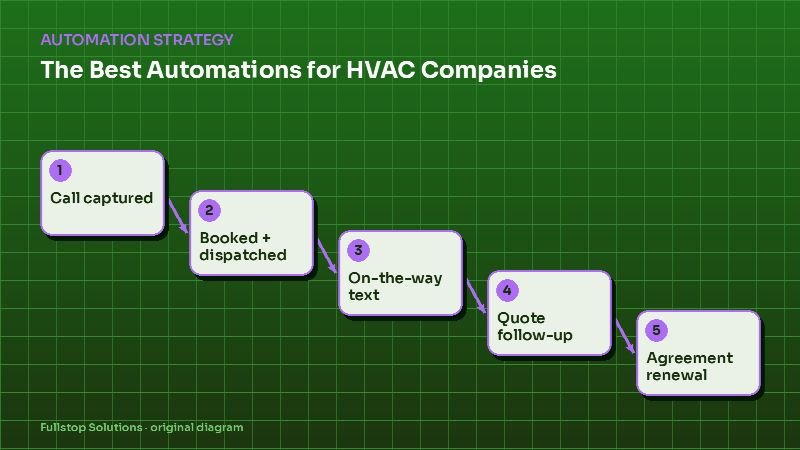
Short answer: HVAC companies get the most from automating six things: capturing calls during peak weather, booking and dispatch, technician on-the-way texts, replacement quote follow-up, maintenance agreement renewals and tune-up scheduling, and review requests. The first two protect revenue in the busiest weeks; the last three build steadier revenue the rest of the year.
The HVAC demand problem
When the first heat wave or cold snap arrives, calls spike, phones go unanswered and dispatchers fall behind. In milder months, the challenge flips to keeping technicians busy. Automation helps on both sides: it captures and organizes peak demand, and it fills shoulder seasons with maintenance and replacement work. See the seasonal automation calendar for home services.
1. Call capture during peak weather
Every unanswered call in a heat wave is a likely booking with a competitor. The fixes:
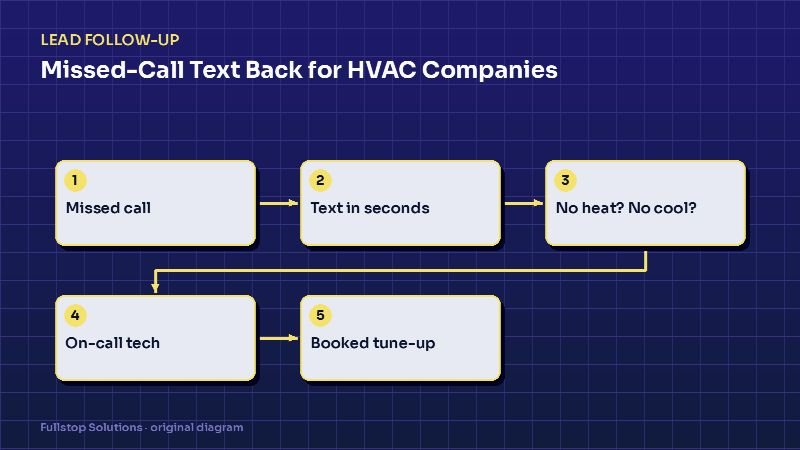
- Missed-call text-back within a minute, with a booking link. See missed-call text-back for HVAC.
- AI receptionist overflow for calls the office cannot pick up, collecting the address, system type, symptoms and urgency.
- Priority rules for no-cool with vulnerable occupants or no-heat in freezing weather.
2. Booking and dispatch
Online and phone bookings land in your field service platform with the right job type and time window. Dispatch automation suggests technicians by skill, location and capacity, and alerts the dispatcher to conflicts. See field service dispatch automation.
3. On-the-way and job updates
Customers get a text when the technician is on the way, with the tech's name and photo if you choose, and an update if the window changes. After the visit, they receive the invoice and any recommendations. This reduces "where is the tech?" calls in the busiest weeks.
4. Replacement quote follow-up
System replacements are high-value decisions that customers take time over. A structured follow-up sequence:
- same day: the quote with options, financing links if you offer them, and an easy way to ask questions,
- a few days later: a check-in from the comfort advisor,
- a week later: a helpful message, such as how to compare options,
- later: a final check before closing the quote.
Replies route to the advisor. Messages about incentives should link to current official information, such as ENERGY STAR's federal tax credits page, rather than promise amounts, because programs change. See heat pump installation automation.
5. Maintenance agreements
Offer after a repair visit, when the value is fresh.
Schedule spring cooling and fall heating tune-ups automatically, in batches by area to keep routes efficient.
Renew with reminders ahead of expiry, and a task for staff if a member does not renew.
Agreements turn one-time customers into repeat ones and smooth workload into shoulder seasons.
6. Reviews
After completed jobs, ask every customer the same way for a review. Do not filter or incentivize. See review request automation.
Commercial HVAC
Commercial customers need different automation: preventive maintenance schedules by site, work order intake from property managers, purchase-order tracking and invoice delivery to accounts payable. See commercial HVAC automation.
Sequencing
- Before peak season: call capture and on-the-way texts.
- During peak: monitor and tune.
- Shoulder season: replacement quote follow-up and maintenance agreements.
- Ongoing: reviews.
What to measure
Unanswered call rate during peaks, booking rate, average time to dispatch, replacement quote close rate, agreement count and renewal rate, and review volume. Pull a baseline from your phone system and field service platform first.
Mistakes to avoid
Launching call capture in the middle of a heat wave. Build it beforehand.
Generic quote follow-up. Messages should reference the customer's actual options.
Agreement renewals without a human backstop. Members who do not renew should get a call.
Promising incentives. Link to official sources instead.
Questions to settle before you build
Which field service platform and phone system do you use? What counts as an emergency for priority routing? Who owns replacement quotes, and how long is a quote open? What do maintenance agreements include, and how are renewals handled today? These answers shape every workflow above.
One hot afternoon, step by step
At 3:10 p.m. on the first very hot day of the season, the office has three lines busy. A fourth caller hangs up. Within a minute they receive a text: "Sorry we missed you. Is your AC not cooling? Reply with your address, or book here." They reply that the system is blowing warm air and there is an elderly parent at home.
The reply is tagged as a priority no-cool call and appears at the top of the dispatcher's board. The customer receives a confirmation with a window. Another caller reaches the AI receptionist on overflow, which collects the address, system age and symptoms, and books the next standard slot.
At 5:30 the technician marks the first job finished. The customer receives the invoice and a note that the system is near the end of its expected life, with a link to request a replacement estimate. They click it, and the comfort advisor gets a task for the next day.
Two days later, the replacement quote follow-up sequence begins. Three weeks after that, the customer, now with a new system, is offered a maintenance agreement.
Sizing your peak-season leak
From your phone system, take the number of unanswered calls on your five busiest days last year. Multiply by the share of answered calls that usually book, then by your average repair ticket. That is a rough upper bound on what went unanswered on those days, in your numbers.
Where to start
Check your phone system for unanswered calls during the last peak week and count open replacement quotes; the bigger number usually tells you where to begin. Our HVAC automation page and lead intake and follow-up service cover the details.