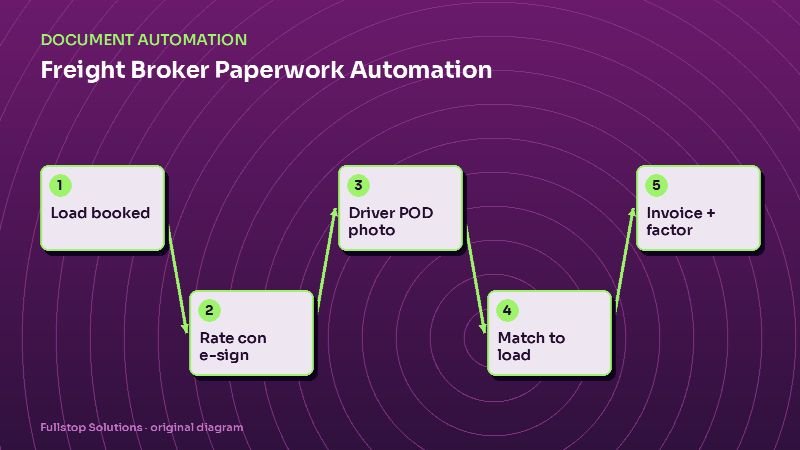
Short answer: freight paperwork automation sends rate confirmations for e-signature as soon as a load is booked, collects and checks carrier onboarding packets, captures bills of lading and proof-of-delivery documents from driver photos, matches each document to the right load, and triggers invoicing or factoring the same day. Brokers and small carriers get paid faster and spend less time chasing PDFs.
Why paperwork controls cash flow
In freight, a load is not finished when it is delivered. It is finished when the signed POD is in hand, the invoice is sent and the payment arrives. Every day a POD sits in a driver's cab or an unread email is a day of delayed cash. For small brokerages and owner-operators, that gap can decide whether payroll and fuel are covered.
The documents are predictable: rate confirmation, carrier packet (authority, insurance certificate, W-9, agreement), BOL, POD, lumper receipts, accessorial documentation, invoice. Predictable documents are automatable.
The automated flow
1. Carrier onboarding
When a new carrier is set up, they receive an onboarding link to complete the broker-carrier agreement, upload their certificate of insurance and W-9, and provide payment details. The system checks basic public data, such as the carrier's operating status in FMCSA's company snapshot, and flags issues for a person to review. Insurance expiration dates are tracked, with renewal reminders before they lapse.
2. Rate confirmation
When a load is booked in the TMS, the rate confirmation is generated with the agreed rate, pickup and delivery details and accessorial terms, then sent for e-signature. Unsigned confirmations trigger a reminder and a dispatcher alert before pickup.
3. Load updates
Check calls and tracking updates can be automated through tracking integrations, with exceptions (late pickup, missed check-in) alerting the dispatcher rather than requiring constant manual calls.
4. BOL and POD capture
Drivers text or upload photos of the signed BOL and POD to a dedicated number or app. The system:
- reads the load, PRO or reference number,
- matches the document to the load in the TMS,
- checks that the image is legible and includes a signature,
- flags notations such as shortages or damages for review,
- files the document with the load.
Poor photos get an immediate "please retake" reply while the driver is still at the dock.
5. Invoicing and factoring
When a POD is matched and clean, the invoice is generated with the rate confirmation and POD attached and sent to the shipper or customer portal. If you factor, the package is submitted to your factoring company in the format they require. Accessorials (detention, lumper) are added when their supporting documents are present.
6. Carrier payment
For brokers, carrier payables can be released according to your terms once the POD and carrier invoice are in, with quick-pay options handled by rule.
Owner-operators and small fleets
Owner-operators handle all of this alone, often from the cab. A simplified version helps a lot: photo-to-invoice for PODs, automatic factoring submissions, fuel receipt capture for IFTA records, and reminders for insurance and permit renewals. See owner-operator automation.
Fraud awareness
Freight fraud, including identity theft of carrier authorities and double brokering, is a known industry problem. Automation can help with consistency checks (does the carrier's contact information match their records? did the payment details change recently?), but it does not replace your vetting process. Treat any change in payment details as a red flag requiring human verification.
Systems
Brokerages use TMS platforms such as McLeod, Aljex, Tai, Revenova and others; small carriers often use simpler dispatch and accounting tools. Integration depth varies. Document capture typically connects through the TMS API or through email and file-based imports.
Measuring the impact
Track, before and after:
- days from delivery to POD received,
- days from delivery to invoice sent,
- days sales outstanding,
- hours per week spent on paperwork,
- loads with missing documents at month end.
Mistakes to avoid
Accepting blurry PODs. Bounce them immediately while the driver can retake.
Auto-approving payment detail changes. Always verify by a trusted channel.
Ignoring accessorial documentation. Detention and lumper charges need proof; capture it with the POD.
Questions to settle before you build
Which documents must be present before an invoice goes out, for each customer? Which customers require invoices through their own portals? Which factoring company do you use, and what format does it require? Who verifies new carriers and any changes to payment details? What counts as a clean POD for your customers, and how should notations be handled? Writing these rules down once lets the automation apply them on every load, including the ones that come in at 11 pm on a Friday.
One load's paperwork, start to finish
A shipper emails a load tender. The automation reads the pickup and delivery details, commodity, weight and rate into the TMS as a draft load for the broker to check. Once the broker books a carrier, the system verifies the carrier's details against your onboarding records and checks their authority status with the FMCSA records your team uses.
The rate confirmation is generated from the load data and sent for e-signature. When the carrier signs, the load moves to "dispatched" and the shipper gets a confirmation.
At pickup, the driver texts a photo of the bill of lading. The document is classified, attached to the load and the key numbers are checked against the order. At delivery, the proof of delivery arrives the same way. A missing POD after the expected delivery time triggers a reminder to the carrier.
With rate confirmation, BOL and POD on file, the shipper invoice is generated and sent with the documents attached, and the carrier payment is queued according to your terms. An exception, such as a weight that differs from the order, goes to a person instead.
Working out the paperwork cost
Multiply your monthly load count by the minutes staff spend on each load's documents, from tender to invoice, and your loaded hourly cost. Add the cost of late invoices: the average days between delivery and invoicing, times your typical daily cost of money owed. These two numbers show what document automation is worth to your brokerage.
Where to start
Start with photo-based POD capture and same-day invoicing; it shortens your cash cycle quickly. Add rate-confirmation automation and carrier onboarding next. Our freight brokerage page and trucking and logistics page list the full set of workflows, and the document processing guide explains the pipeline.