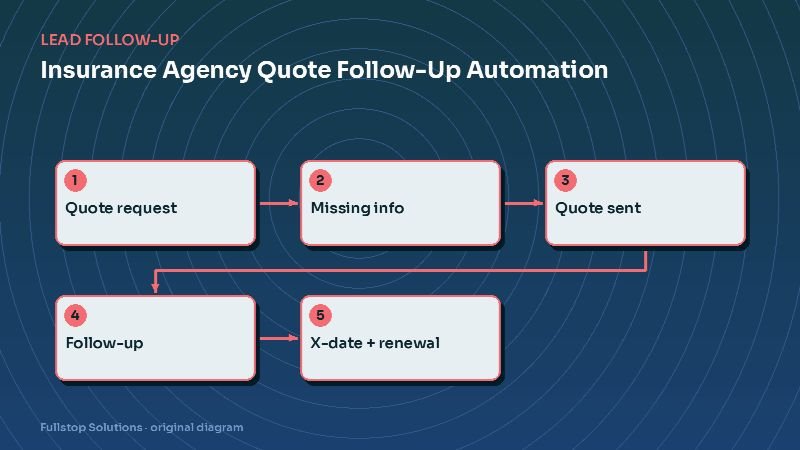
Short answer: most insurance agencies lose quotes in the quiet period after the quote goes out, and lose prospects who said "call me at renewal" because nobody remembered. Automation fixes both. It chases missing information, follows up on every sent quote on a schedule, stores X-dates and triggers outreach weeks before them, and starts renewal reviews early for existing clients. Producers still give the advice; the system makes sure they have someone to advise.
Where agency revenue leaks
Talk to any agency owner and the same leaks come up:
- Incomplete quote requests. A web lead gives a name and a phone number, but no vehicle information, no current carrier and no prior claims. A CSR has to chase it by phone.
- Quotes that go silent. A quote is emailed, the prospect does not reply, and the CSR moves on to the next fire.
- Lost X-dates. "I'm with my current carrier until March" is said on a call and written nowhere useful.
- Late renewals. Renewal reviews start when the renewal notice arrives, which is too late to remarket the account comfortably.
- Cross-sell gaps. An auto client with no home, umbrella or life policy is never asked.
Each of these is a reminder problem. Automation is very good at reminders.
Step 1: Complete the quote request
When a quote request comes in from your website, a comparative rater or a lead vendor, the system sends an instant reply and a short, line-specific form:
- Personal auto: drivers, vehicles (VIN if possible), current carrier and limits.
- Homeowners: address, year built, roof age, current carrier.
- Commercial: business type, revenue range, employee count, current policies and expiration dates.
Answers write directly into your agency management system or rater, so nobody re-keys them. If the form is not completed within a day, one friendly reminder goes out, then the lead goes to a CSR's call list.
Step 2: Quote follow-up that does not quit too early
A practical cadence after a quote is sent:
- Same day: "Your quote is ready. Here is a summary and a link to review it with [producer]."
- Day 2: "Any questions about the coverage options? Reply here or book 10 minutes."
- Day 5: a short note from the producer's address.
- Day 10: "Should I keep this quote open, or would you like me to check back closer to your renewal?"
That last message is the important one: it turns a dead quote into an X-date.
Step 3: X-date capture and outreach
Whenever a prospect gives an expiration date, it is saved as a field on their record. The automation then:
- schedules a reminder to the producer about 45 to 60 days before the date (your choice),
- sends the prospect a short, permission-based message: "Your policy renews around March. Would you like us to re-quote in February?"
- creates a task if they say yes.
Over a year, the X-date list becomes one of the most valuable assets in the agency.
Step 4: Renewal reviews
For existing clients, renewal automation starts early: a check-in roughly two months before renewal asking about changes (new driver, renovation, new vehicle, business growth), followed by a review booking link. When premiums rise, clients who heard from you before the bill arrived are much easier conversations.
Step 5: Cross-sell, carefully
A gentle annual "coverage check" that asks about life events (new home, teen driver, new business) gives producers natural cross-sell openings. Avoid blanket product blasts; they feel like spam and invite opt-outs.
Line-specific notes
Personal lines (auto and home): high volume, short cycles. Speed and completeness of the quote request matter most. See auto and home insurance automation.
Commercial lines: longer cycles, more documents (loss runs, applications, certificates). Automation helps most with document collection and certificate-of-insurance requests. See commercial insurance automation.
Medicare: strict federal marketing rules, including rules on contacting beneficiaries and documenting scope of appointment. Every automated message should be reviewed against current CMS marketing guidelines. See Medicare insurance agent automation.
Compliance basics
Automated texting and email are covered by federal rules. The FCC's guidance explains that autodialed texts to mobile numbers require consent, marketing texts require written consent, and opt-outs must be honored. The FTC's CAN-SPAM guide covers commercial email: accurate headers, a postal address and a working unsubscribe. State insurance regulations may add requirements for advertising and producer communications, so templates should be approved by your agency's compliance lead.
A worked example with your numbers
Suppose your agency sends Q quotes a month, and right now a fraction F of them get any follow-up after the first email. If a structured follow-up cadence reaches the rest, and some share S of those additional conversations turns into a bound policy with average first-year commission C, the monthly gain is roughly Q × (1 − F) × S × C. Put your real numbers in: if you do not know F, pull 20 recent quotes and check how many got a second touch. That check is usually eye-opening, and it gives you a baseline to judge the automation against.
A quote request, start to finish
A prospect requests a home and auto quote through the agency website on Sunday. They receive an immediate acknowledgment explaining what the agency needs and how quotes work, with a link to book a call. Their consent for texts and calls is recorded with the form wording.
On Monday, a licensed agent calls, gathers the details and prepares quotes. The prospect receives the quote summary by email with a link to discuss. Over the next three weeks, the follow-up sequence sends a check-in, a short explanation of what the coverage options mean in plain terms (reviewed by the agency), and a final reminder before the quote expires. Every reply goes to the agent.
The prospect waits until their current policy is near renewal. Because the CRM records that date, a reminder goes out a few weeks before, and the agent calls. The prospect binds the policy. Coverage advice came from the licensed agent throughout.
Measuring it
Track per producer and per line: quote-request completion rate, quotes with at least three follow-up touches, close rate on quotes, X-dates captured per month, and renewal retention. Compare against the same quarter last year where possible.
Where to start
Start with the quote follow-up cadence and X-date capture; they turn existing effort into more bound policies without buying more leads. Add quote-request completion next, then renewal reviews. Our insurance agency automation page lists the full set of workflows, and the lead follow-up pillar guide explains the general framework.